

The ROI of a mentoring programme depends less on your mentors than most people think.
Most funders and organisational leaders assume mentoring succeeds because mentors are skilled, generous or inspiring. While those qualities matter, they are rarely the real determinant of whether a mentoring programme delivers its intended impact.
The real driver is structure, by which we mean the decisions, clarity, preparation and support that the programme manager is expected to provide.
This structure also enables the mentor’s skills, generosity and inspiring nature to be harnessed and turned into positive change. Without it, you aren’t getting as much from the programme as you could.
When that capability is missing, the programme may still run. But it becomes fragile. Teams work harder. Impact softens. Reporting becomes guesswork. And the hidden cost of “figuring it out as you go” starts eating into the value of the grant.
Funders and implementing organisations rarely see this risk until the programme slows down or stalls. But by then, the cost, financial and human, has already multiplied.
The hidden workload that no one budgets for
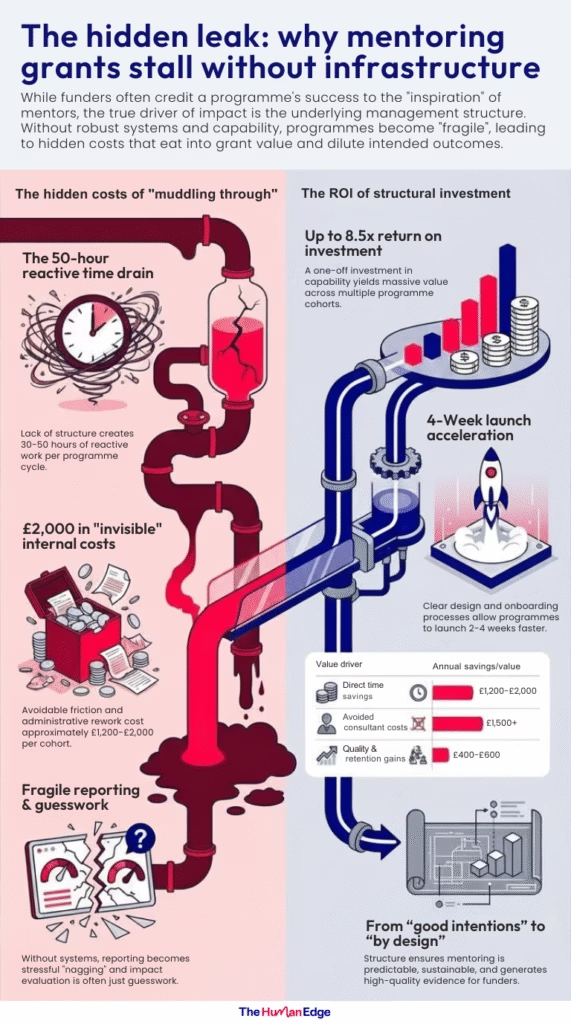
A typical mentoring cycle, without sufficient programme management capability, generates an extra 30 to 50 hours of reactive work for the programme manager.
This is time spent:
- Clarifying expectations that were never set
- Managing mismatches that could have been avoided
- Responding reactively instead of guiding proactively
- Answering the same questions repeatedly
- Gathering data the programme wasn’t structured to collect
- Trying to re-engage participants when motivation dips
- Justifying a programme that isn’t generating results
At a conservative loaded cost of £40 per hour, that is £1,200 to £2,000 per cycle in avoidable internal cost and it prevents them from doing other value adding work.
This is just the direct time cost. The wider friction points are harder to quantify but equally real:
- Mentors disengage when guidance on their role and responsibilities is unclear
- Mentees disconnect when preparation is weak
- Matches start off on shaky ground and often end early
- Support feels ad hoc and process driven rather than human driven
- Reporting becomes stressful and seen as nagging
- Evaluation becomes a guess
- Each cycle feels like starting from scratch
The programme manager becomes the bottleneck and disengages from their role as limited progress and impact is created
Mentoring develops a bad reputation and any future programmes are met with scepticism, putting people off looking for mentoring in their lives
Most teams feel these symptoms. Few realise they all stem from the same source: insufficient system and capability.
Why the right system and programme management capability are essential, not optional
Many organisations assume the answer is more content, more templates or more mentor training. They’re missing the point. What’s actually needed is two things:
- A system: the framework, tools, processes and structure that create clarity and consistency across the programme.
- The capability to run it: the knowledge, confidence and skills that allow programme managers to use that system effectively and adapt it to their context.
Both are essential. A system without capability becomes a rigid checklist. Capability without a system becomes improvisation. Together they form the foundation that prevents predictable problems and protects the investment behind the programme.
The right system and capability give organisations:
- Clear programme purpose and expected outcomes
- Transparent mentor and mentee selection
- Readiness checks before recruitment
- Clear and consistent matching criteria
- Structured, human and relationship-centred support rhythms across the cohort
- Defined roles and boundaries that prevent confusion
- Shared language across participants
- Tools for reflection and troubleshooting
- A reliable way of capturing learning and evidence
Without this, mentoring depends on good intentions and motivations. With it, mentoring becomes predictable, impactful and sustainable.
And importantly for funders it increases the impact and outcomes from the investment, reduces delivery risk, strengthens partner confidence and improves the quality of evidence for future grants. It protects grant investments from one of the most common but least visible failure points: weak programme management infrastructure.
The financial impact of doing it well
When programme managers are equipped with systems and capability, organisations see:
Direct time savings: £1,200–£2,000 per cycle
The 30-50 hours of reactive work simply doesn’t materialise. Problems that would have consumed days get prevented or resolved quickly.
Quality, retention and engagement gains: £400–£600 per cycle
Better matching, clearer communication and structured support mean 10-15 fewer hours spent on rework, re-matching or damage control.
Avoided consultant costs: £1,500+ per cycle
Common, predictable problems get handled internally rather than requiring external expertise to diagnose and fix.
Launch acceleration
Mentoring programmes launch 2-4 weeks faster when design, matching and onboarding processes are clear from the start. This creates significant value through earlier impact.
Combined, this represents £3,100 to £4,100 in measurable annual value per cohort, using conservative assumptions.
How the numbers work over time
Building internal capability requires upfront investment. A structured training programme like The Human Edge’s REMP Online course costs between £1,399+VAT and £3,879 +VAT, depending on the level of support and organisational needs.
To assess whether this investment makes sense, organisations need to look beyond the course fee and focus on the value created once the system and capability is in place, and the ongoing benefit gain thereafter.
What “value” means in practice.
Value is the tangible benefit gained from running mentoring more effectively in house. It comes from reduced external delivery and design costs, fewer programme errors, less staff time spent fixing issues, stronger and more consistent outcomes per cohort, stronger appreciation of mentoring resulting in higher quality applications and deeper participant commitment within and beyond the programme and delivery of a valuable initiative.
Year one
A trained internal team delivers a full mentoring cohort using a proven system. Value begins once the first cohort is live and most of delivery activity replaces external spend or inefficient internal effort. Typical value created per cohort is £3,100 to £4,100 (as shared above).
Simple payback example.
An organisation invests £1,399. The first cohort runs for 9 months and delivers £3,100 of value over that period. This equates to an average of roughly £345 of value per month during delivery. Allowing for initial setup and mobilisation, the original investment is typically recovered by month 5 of the cohort.
At the higher tier, an organisation invests £3,879 and delivers £4,100 of value over a 9-month cohort. This equates to roughly £455 of value per month during delivery. With value accruing once delivery is underway, payback occurs around month 9.
Year two
The same capability is reused to deliver a second cohort. No additional training investment is required. A further £3,100 to £4,100 in value is created.
Year three
The organisation delivers a third cohort using the same system and tools. Another £3,100 to £4,100 in value is realised.
Over three years this delivers £9,300 to £12,300 in total value from a one-off investment of £1,399 to £3,879. This represents a return of approximately 3x to 8.5x depending on tier and outcomes achieved.
These figures assume one cohort per year. Organisations running multiple cohorts annually see proportionally higher returns, as the same capability serves each additional cohort without further investment.
This is not a one-off training effect. What stays inside the organisation is the mentoring framework, tools, processes, learnings, confidence and the judgement.
This internal asset supports repeated high-quality delivery without buying the same expertise again and continues to generate value over time.
What changes beyond the spreadsheet
The financial case is clear. But the qualitative shifts matter just as much:
- Programme managers regain clarity, confidence and satisfaction. They stop firefighting, start guiding and recognising results.
- Mentors feel anchored rather than alone. They know what success looks like and how to get support when they need it.
- Mentees feel prepared rather than uncertain. They understand their role and how to make the most of the relationship.
- Leadership sees momentum instead of friction. The programme finally works as intended.
- Donors see evidence instead of anecdotes. Impact becomes something you can demonstrate, not just describe.
- When these elements align, mentoring becomes what it should be: purposeful, human, sustainable and easier to scale.
The economics of structural investment
Treating mentoring programme management as something that can be improvised introduces unnecessary risk. It creates avoidable burnout in teams. It dilutes impact and erodes the value of your funding.
Without investment in systems and capability, organisations typically either muddle through with the hidden costs outlined above or hire external consultants repeatedly at £1,500+ per cycle and cohorts to solve predictable problems.
Investing in systems and capability changes the equation. It protects your investment from predictable failure. It strengthens your team, your partners and those they are looking to benefit from the mentoring. More importantly, mentoring stops depending on good intentions and motivations and starts working by design.
This is what organisations gain when they invest in the system and capability that no one sees but everyone feels.
What would it mean for your organisation if mentoring actually worked the way it should?
How REMP Online can help
REMP Online provides structured training and systems for mentoring programme managers. You’ll gain both the system and the capability to deliver effective mentoring that creates real impact.
Learn more: visit https://humanedge.org.uk/running-effective-mentoring-programmes/ or contact us to discuss your specific needs at info@humanedge.org.uk
The data in this analysis reflects conservative estimates based on typical programme costs and time investments.