
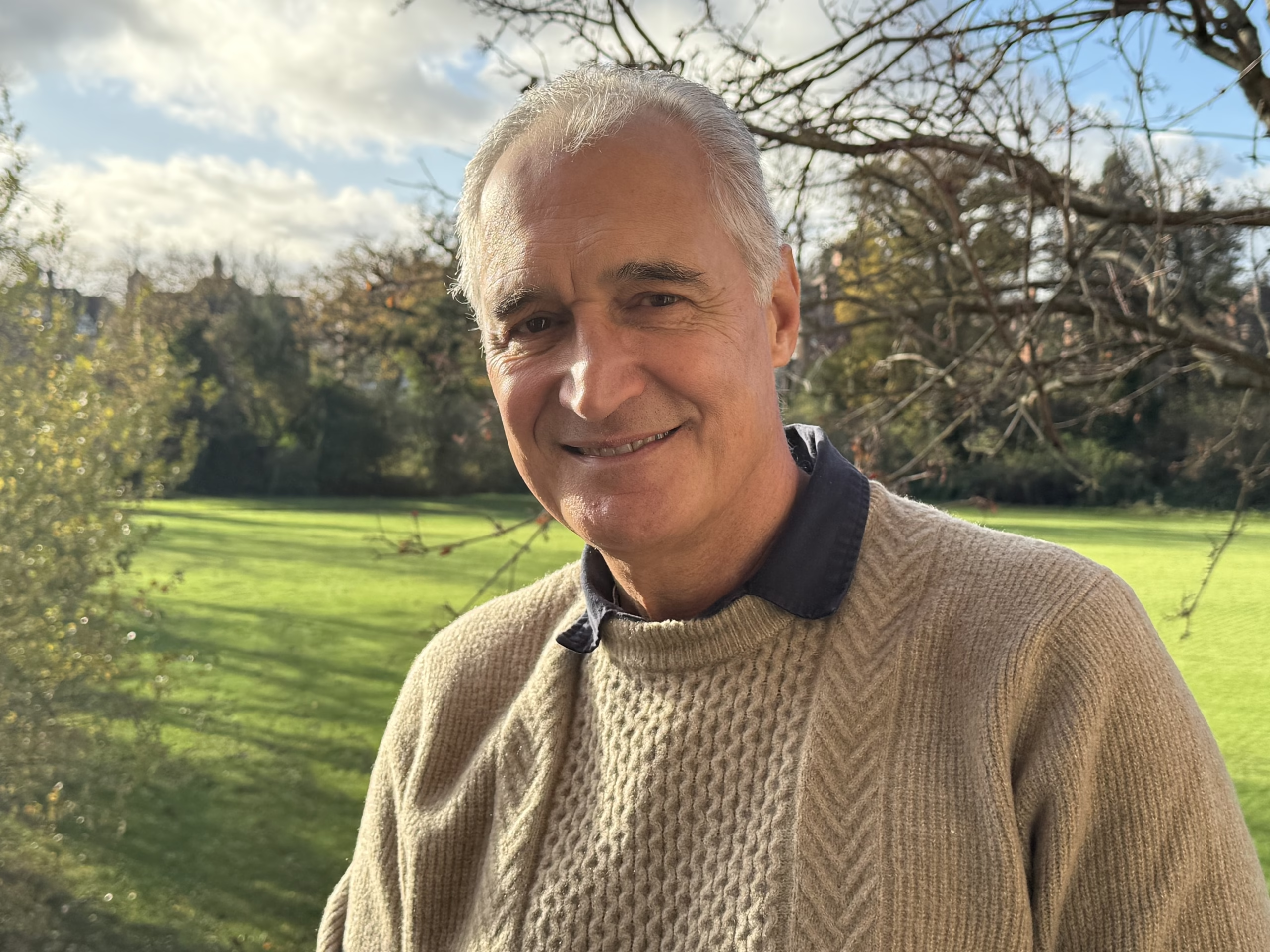
Craig Preston has spent over 30 years leading in environments most of us will never experience, from military command to corporate boardrooms, from Northern Ireland to the Middle East. Now, as The Human Edge’s newest board member, he’s bringing that hard-won wisdom to our mission of making mentoring accessible and transformative. We sat down with Craig to explore what truly makes a great leader, why mentoring fills a gap that coaching can’t and his vision for expanding our work.
The leader who learned from being badly led
Can you tell me about a moment that shaped your understanding of leadership?
Funny enough, what I remember most is very early on in my working life when I experienced being really poorly led. Before I joined the army, I worked on a farm. The farmer would ask you to do tasks on equipment you hadn’t been trained on, give very poor direction, then publicly humiliate you when you couldn’t do the task.
I was 18, maybe 19. It made me feel horribly inadequate. So I left as fast as I could.
The big lesson was the absolute need to provide people working for you clear direction and proper training to give them a chance to do the job properly. I see this time and time again in organisations now: people are put into roles where their skills are not fully developed but are then held to account when they can’t perform.
And then the military showed you the contrast?
Exactly. When I joined the army, I entered a completely different world where you were never asked to do something unless you’d been trained first. The relief of being able to do things properly because I’d been given the training, the equipment to do so.
I also learned that calmness is contagious. Working under pressure in Northern Ireland, I witnessed leaders who were amazingly calm in intense situations. There’s a phrase the military uses: “Officers don’t run because it frightens the troops.”
From bullets to fizzy pop
You eventually transitioned to Coca-Cola. How did military leadership translate to the corporate world?
I didn’t know what leadership should look and feel like in fast-moving consumer goods. So I said, “I’ll just stick to what I learned in the military.” Visibility, clear communication, having people’s backs, leading by example.
It worked. This was a bit of a light bulb moment: it doesn’t matter what the context is. Leadership’s leadership. It’s creating an environment where the people you lead can perform. It’s not about your performance. It’s about how well the people you lead can perform.
In some ways it was a blessing that I didn’t know anything about the product because I couldn’t tell anybody how to do their jobs. I focused on: Are you OK? What help do you need?
You mentioned a principle called “catch people doing something right”?
Yes, from The One Minute Manager by Kenneth Blanchard. I’d take sales team members to visit their best clients, let the customer praise them, then reinforce that affirmation afterward. “Fantastic, what a great job you’re doing.” That’s uplifting, it’s reaffirming. Far better than trying to catch their mistakes, finding problem areas, particularly if you’re not better than them.
Leadership needs management (and vice-versa)
Your understanding of leadership evolved at Coca-Cola. What changed?
I realised that leadership wasn’t everything. And I realised that without management, you don’t know where you are.
Leadership is the soft stuff: inspiring, motivating, giving clear direction. It’s taking people to a place they’ve not been before. Management is checking you’re on track, having the data to say: “We are where we should be.”
Leadership without management just makes you feel good, but you get to the end and realise you’ve missed your target. Management without leadership means people know they’re behind but have no motivation to catch up. You need both.
And it’s when things get tough that sadly we often get sucked into more management. The leader says, “I need reports every day.” So everyone spends their whole time preparing reports rather than getting stuff done. What we actually need is more leadership.
When you’re ticking over, there’s very little leadership required. When things are tough, that’s when leaders earn their money.
What do you think people get wrong about good leadership?
They confuse good management and leadership. Often very senior leaders are guilty of that because they’re not close to what’s going on. They’re not out there motivating and inspiring. They’re sat in an office looking at a spreadsheet.
The other thing people get wrong is thinking leadership is just about strategy or decision-making. They forget that leadership is also about role modeling: you have to live the standards you set. At Coca-Cola, one standard was that everybody’s vehicles had to be immaculate when visiting clients. That meant they also made sure they were looking smart, the product was clean and tidy, they were efficient. It was a symbol of being professional. That applied to everyone, including me. If I’d demanded that but turned up in a messy car myself, it would have meant nothing. You can’t just tell people what to do – you have to show them.
The future of leadership
How do you see AI impacting leadership and mentoring?
AI will change how we lead, no question. It means better data, better information, clearer recommendations. The management piece gets easier – tracking performance, identifying patterns, making predictions
But that’s precisely why the human side of leadership becomes more important, not less. As AI handles more of the operational work, leaders will need to focus even more on what AI can’t do: reading a room, noticing when someone’s struggling before the metrics show it, understanding what’s going on in people’s lives that affects their work.
A leader can work that out intuitively – they can see it in how someone shows up, ask “How was your son’s birthday party?” and read the reaction. AI can’t do that. And as AI takes on more management tasks, that human edge becomes the leader’s primary job. That’s where mentoring becomes even more critical, by helping leaders develop those relational and intuitive skills that AI will never replace.
Why mentoring matters
What is something that mentoring provides that coaching doesn’t?
A pure coach doesn’t offer solutions. Mentoring provides potential answers to challenges that coaching on its own doesn’t address. My first real mentor was my company commander in the army. He’d say things like, “By the way Craig, in my experience, attending coffee morning every morning in the officers’ mess is a really good thing because it’s the only time you get to meet everybody.” It wasn’t coaching, it wasn’t skills training. It was sharing experience. You don’t know what you don’t know.
At The Human Edge, we talk a lot about mentoring as a relational way of leading. What does that mean to you?
That really resonates with me. Some of the most formative moments in my career came from people who didn’t just instruct me, they invested in me.
That’s what makes mentoring so powerful: it’s deeply relational. It’s built on trust, openness and genuine connection, not authority or hierarchy.
It isn’t about giving advice or fixing people. It’s about listening, asking the right questions, offering challenge and care. It’s about helping someone unlock what’s already there, what they already know but maybe haven’t articulated yet.
In leadership, that mindset is crucial. Relational leadership isn’t about having all the answers, it’s about creating the kind of space where others can think, grow and contribute. Often, what people need most is someone to walk alongside them, not in front of them. Not someone telling them what to do, but someone who’s been there saying “In my experience, here’s what worked” or “Have you thought about this?”
Joining The Human Edge
What made you say yes to joining The Human Edge’s board?
It felt values-aligned. You’re doing work that matters and you’re doing it with integrity. That’s rare. I also felt a connection to the work you’re doing with mentoring. I’ve spent years developing leaders across sectors and geographies and I’ve seen how powerful it is when development is rooted in relationship not just tools or content. Mentoring does that. It holds space for people to grow in real, human ways. It doesn’t just build skills, it builds capacity.
Spending time with Kat, on the board meeting, with Peter, there’s a natural fit. No sharp edges. And I thought, “Yes, this is it. More people should have access to this.”
I hope to bring perspective, ask the right questions and support the team to scale what they’re doing without losing that clarity and soul. Particularly in the Middle East, where there’s real scope to raise awareness of what mentoring is and establish effective programmes where they don’t exist.
Any final wisdom on leadership?
Leadership isn’t about titles or authority. It’s about how you show up, day after day, especially when things get hard. It’s not something you are. It’s something you do and keep learning how to do better.
That’s where mentoring comes in. It helps leaders develop the judgement, presence and relational skills to lead themselves and others in real, human ways and to create environments where others can thrive.
Because in the end, leadership is a practice, not a position.