
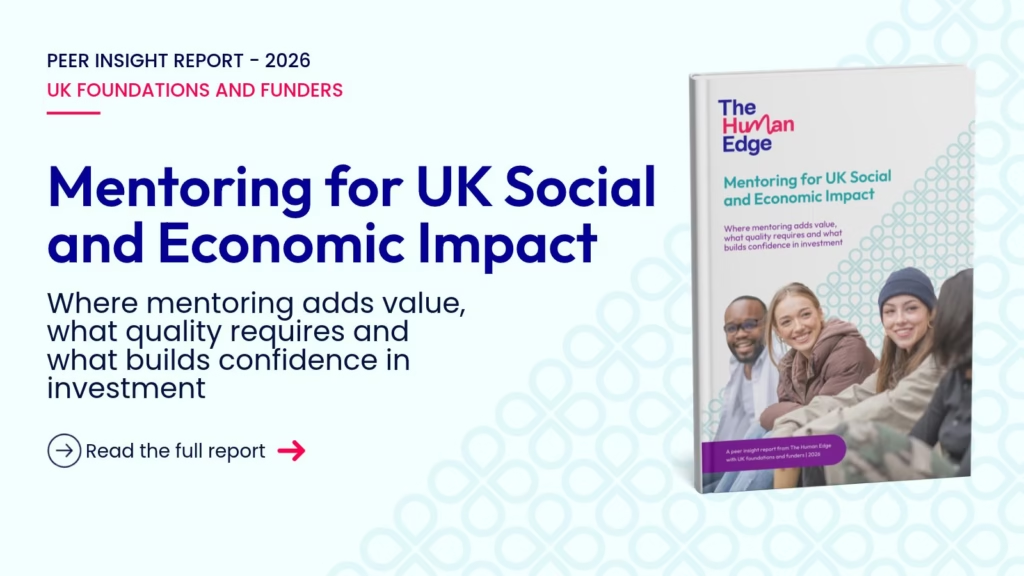
New research from The Human Edge, drawing on insights from 33 senior professionals across UK foundations, funders and delivery organisations, explores where mentoring adds value, what quality mentoring requires and what evidence builds confidence in investment and its contribution to social and economic outcomes.
London, 11 November 2026 – Foundations and funders across the UK invest in mentoring to support entrepreneurs, young people, social and charity leaders and organisations. Yet knowing whether that investment is delivering meaningful value is often harder than it looks.
New research from global capacity-building organisation The Human Edge suggests that confidence comes from understanding what sits behind a mentoring programme: how it is designed, managed and supported, what the investment makes possible and whether the evidence gathered provides a meaningful picture of its contribution.
Mentoring for UK Social and Economic Impact: Where mentoring adds value, what quality requires and what builds confidence in investment draws on insights from 28 UK foundations and funders investing in mentoring and four delivery organisations.
Confidence is built in the conditions around the relationship
The research finds that the conditions surrounding the mentoring relationship can matter just as much as the relationship itself. These include:
- clear programme goals and thoughtful design
- recruitment and selection of mentors and mentees
- mentee and mentor preparation
- thoughtful matching
- capable programme management
- ongoing support for participants
- safeguarding, boundaries and access to specialist support where needed
- monitoring, evaluation and learning.
Programme management stands out as one of the most important and most overlooked parts of the investment. The research distinguishes between capability, meaning the knowledge, skills and judgement needed to manage a programme well, and capacity, meaning the time, resources and authority to do so. Both are needed if programmes are to adapt and respond to participants’ needs and changing circumstances.
These requirements also have implications for how funders assess the cost of mentoring. Respondents described a wide range of funding models, with investment sometimes extending well beyond the relationship itself. Rather than setting a benchmark, the research shows why costs are hard to compare when mentoring sits within wider initiatives or accounts for staff time and organisational support differently.
For funders, the question is therefore not simply how much a mentoring programme costs, but what that investment covers and whether the resources available are appropriate to the programme’s aims and delivery requirements.
What evidence gives funders confidence?
Understanding what a programme needs to deliver well is one part of the investment decision. Understanding whether it is making a difference is another.
The research challenges the assumption that greater confidence necessarily comes from collecting more data. Respondents pointed instead to gathering evidence that reflects what mentoring is expected to influence and when. That can include evidence about participants’ readiness and participation, delivery quality, the quality of relationships, outcomes in the shorter term and contribution over the longer term. Each provides a different perspective on how a programme is working and what it may be achieving.
Mentoring will rarely be the only influence on outcomes such as progression in education or employment, career development, stronger leadership or organisational resilience. Its contribution needs to be understood within the wider support and context in which it operates.
For funders, this makes it important to consider evidence from the outset: what outcomes matter, what changes can reasonably be expected through mentoring and what information will help assess progress and inform future programming and investment decisions. Participation figures and positive feedback can offer useful insights, but they do not necessarily demonstrate a programme’s wider contribution.
“Foundations aren’t short of commitment to mentoring. What they often lack is a clear way to see what sits behind a good programme and one of the most interesting things to emerge from this research was how differently mentoring is understood, used and valued across funding organisations. It plays a role in addressing some of the UK’s most pressing social and economic challenges, yet we don’t always have a shared understanding of what good mentoring looks like or how to recognise its contribution. This research gives us an opportunity to learn from one another, ask better questions and build a clearer understanding of how we make the most of mentoring’s potential to meet the human and relational needs of today, helping people build meaningful connections, grow in confidence and develop the skills to navigate an increasingly complex world.” – Kat Bury, CEO, The Human Edge
Growing reach without losing quality
Investment decisions also need to consider what happens when a programme grows. Reaching more people may extend access to mentoring, but it can also place greater demands on mentor supply, preparation, programme management capability and capacity and ongoing support.
The research highlights the importance of considering how these requirements will be met as programmes expand. Scaling mentoring is not simply a matter of creating more relationships; it also means ensuring that the conditions needed for quality can be sustained.
The potential value can also extend beyond individual relationships. Across cohorts and alumni networks, relationships, learning and capability can continue to develop well after a programme has ended. The extent of this wider contribution will depend on the programme and its context, but it offers another reason to look beyond immediate participation and activity when considering value.
A practical framework for funders
To help foundations and funders’ conversations about mentoring investment, The Human Edge has developed a Funders’ Reflection Framework.
The framework brings together six connected lenses to support conversations about mentoring investment, whether before a funding decision, during programme delivery or when reviewing mentoring across a wider portfolio. It is not intended to be a scorecard, maturity model or quality standard, but a practical structure for exploring what a programme is expected to achieve, what it needs to deliver well and what evidence can help assess its contribution.
NOTES TO EDITORS
About The Human Edge
The Human Edge is a global capacity building organisation. We strengthen the people, organisations and networks creating positive social, environmental and economic change, because lasting impact happens when all three grow together. We work with entrepreneurs and social leaders to strengthen their leadership and navigate complexity, and we help turn that individual growth into stronger organisations and thriving peer and alumni communities where relationships, knowledge, collaboration and mutual support keep creating value long after a programme ends. Over 18 years, mostly across the Global South, we have delivered more than 195 programmes in 25 countries, supported over 4,000 leaders from more than 50 nationalities and partnered with more than 60 organisations, from professional membership bodies to foundations and corporates.
About the research
The Mentoring for UK Social and Economic Impact research was conducted by The Human Edge between March and May 2026, combining in-depth interviews and written survey responses from 33 senior professionals across the UK social and economic development landscape, including 28 foundations and funders and four organisations delivering mentoring programmes. The research explores perspectives on the value of mentoring, the conditions required to deliver quality and how funders assess its contribution to social and economic outcomes. Findings reflect the experiences and perspectives of participants and should be understood in that context, rather than as a statistically representative assessment of the UK funding sector. To protect participant confidentiality, findings are presented in aggregate or attributed only to broad organisational type; no individual organisation is named or ranked without prior consent.
Available for interview
Kat Bury, CEO at The Human Edge, is available for interview.
Media contact
Suhana Chooli – suhana@humanedge.org.uk