
The Human Edge — 2026
How mentoring strengthens conservation and climate ecosystems
Read the paper ↓A sector at a crossroads
"With life on Earth itself at risk, the demands and pressures on today's conservation professionals are huge. The need for leadership development that helps them pioneer and deliver the solutions we need is only growing."
André Hoffmann, President, MAVA Fondation pour la Nature
The natural world is in crisis. Biodiversity is declining at rates unprecedented in human history. The climate emergency is reshaping ecosystems, communities and livelihoods on every continent. The 2024 IPBES Transformative Change Assessment concluded that halting and reversing nature's decline requires fundamental, system-wide shifts in how societies organise, relate and act.
The conservation and climate sector exists precisely to meet this moment. Across the world, thousands of organisations, from global institutions to grassroots cooperatives are doing extraordinary work to protect species, restore habitats, shift economies and build communities that can live sustainably within planetary boundaries. The people leading this work are technically skilled, deeply committed and often working in some of the most complex and under-resourced environments imaginable.
Yet the sector faces a structural problem that sits largely out of view.Conservation efforts have traditionally suffered from fragmentation: siloed working, competition for funding, and a tendency to operate through relatively isolated projects that rarely coalesce into the wider movements they aspire to become.
At the same time, the funding flowing into conservation remains a fraction of what the crisis demands and profoundly unequal in how it reaches the organisations doing the most proximate work. The scale of what is being asked of conservation and climate leaders has never been greater. The pressure on the people carrying that work has rarely been higher.
A story
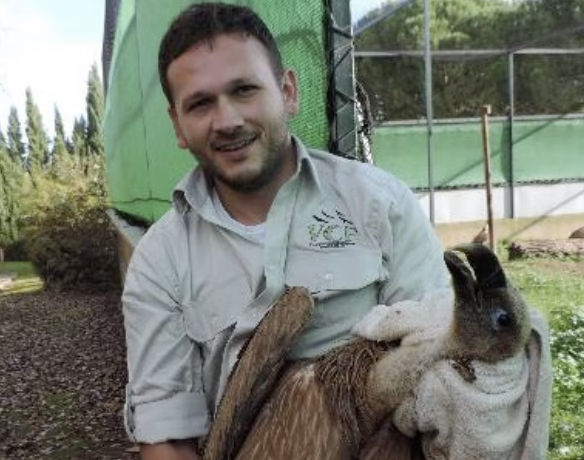
Jovan Andevski
Programmes Manager, Vulture Conservation Foundation (VLF)
Jovan Andevski has worked on vulture conservation across Spain and the Balkans for many years. His journey of personal growth and insight within MAVA Academy has led to better and more effective collaboration. VCF established the Wildlife Crime Academy, a capacity building programme to tackle the urgent need to prioritise and prosecute wildlife crime in 9 European countries, as part of the BalkanDetox LIFE project, alongside the Spanish Government and Junta de Andalucia.
"I realised I should not be afraid to establish personal contact with people and the governmental officials I work with. Now, I have created a true relationship [with them]."
The first and second trainings took place in parallel to the MAVA Academy during which time VCF's approach to the event shifted from educating participants to motivating and engaging people from governmental institutions in conservation efforts.
As a result, the government officials were highly engaged and left motivated to act to ensure wildlife crime is investigated and prosecuted, some for the first time ever. Jovan was inspired by the people-centered approached modelled by the Academy to shape the training programme. With the impact of the Wildlife Crime Academy, Jovan believes that VCF will see immediate and unprecedented changes in the participating countries in government.
"Without the MAVA Academy, the Wildlife Crime Academy still would have happened with this magnitude but not with these results. I wouldn't have achieved the engagement with participants and this is essential to what we're trying to achieve."
Jovan is one of more than 500 conservation and climate leaders The Human Edge has worked with over eight years. His story is specific to him. The pattern it represents is not.
The hidden leadership crisis
There is a particular kind of person who works in conservation and climate. They came to the work through deep knowledge and deeper passion: a biologist who fell in love with a forest, an ecologist who could not look away from a disappearing coastline, an activist who understood that the fight for nature and the fight for community were the same fight.
That passion is the sector's greatest asset. It is also, without the right support around it, one of its most significant vulnerabilities.
In the conservation and climate sectors, 61% of IPCC authors report experiencing grief, anxiety or distress frequently. Two thirds of climate academics have considered leaving the sector entirely because they felt unsupported by institutions and colleagues around them. Across the broader nonprofit ecosystem that houses much of this work, 95% of leaders express some level of concern about burnout, with more than a third reporting it has been a very significant concern in the past year.
These are symptoms of a structural gap.
Many conservation and climate professionals move into leadership positions because of their technical expertise. A biologist becomes a director. An ecologist becomes an executive. None of them were trained for what that transition demands: the people management, the fundraising, the stakeholder navigation, the organisational sustainability that land on their desk alongside the conservation work they came to do.
"I'm a biologist, an environmental scientist. I wasn't educated to manage people or organisations… becoming a better manager, working more effectively with my staff, my volunteers, my trustees, developing as a person — this was the most important part."
Daphne Mavrogiorgos, Director, ARCHELON (Greece) — MAVA Leaders for Nature Academy
Compared to other sectors, conservation professionals have relatively little access to high-quality leadership development. They arrive with the knowledge and the passion. The infrastructure to translate that into sustained, scalable impact is largely absent.
The sector does not lack ambition, expertise or commitment. What it lacks is the relational and leadership infrastructure that would allow those qualities to compound rather than burn out, to build movements rather than isolated efforts, to create organisations that outlast their founders.
What we have seen
We have worked with conservation and climate leaders for year. Across our programmes and more than 500 leaders, one pattern is consistent. Mentoring does not just develop the individual. It builds organisations. And when designed well, it strengthens ecosystems.
The leaders who come into our programmes arrive with deep expertise and genuine passion. What they often lack is the confidence, clarity and resilience to carry the work sustainably.They carry significant emotional weight, often alone. Many have never had a trusted space in which to think out loud about the pressures they face, to admit uncertainty, to receive honest reflection from someone with no vested interest in the outcome other than their growth. Mentoring, at the individual level, provides exactly that. A relationship, a consistent, structured, trust-based space in which a leader can develop the self-awareness, confidence and capability that technical training never touches.
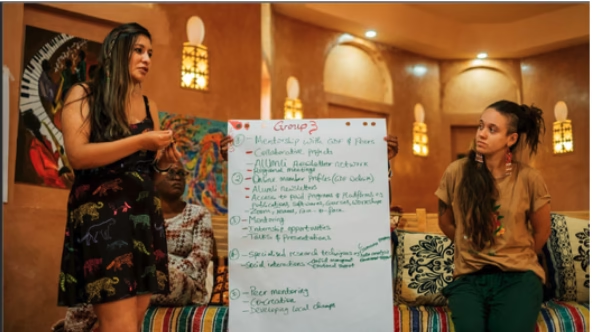
Source: GDF - CCF, Morocco 2025
"I almost cannot believe my own transformation. I feel much more confident now than I used to be and God knows how much I need that for the sort of work I do."
Rachel Ikemeh — Whitley Award Winner, Director
GDF - CCF 2024
Individual growth does not stay with the individual. It moves into teams, into decisions, into the culture of the organisations these leaders run.
Across our programmes, participants consistently report that the shift they experience personally translates into a different kind of leadership inside their organisations: more intentional about developing people, more capable of navigating complexity.
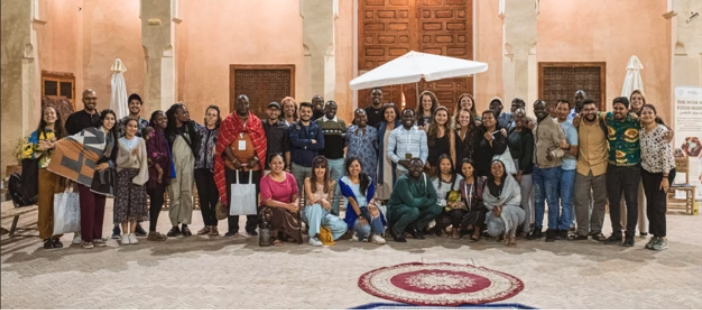
Source: GDF - CCF, 2025
"I now recognise that previously we primarily had an emphasis on the task and outcome of our work, and not on the human and emotional aspects. This renewed focus leads to better results."
Zeljka Rajkovic, Executive Director, Biom Association
MAVA Leaders for Nature Academy
When mentoring is built not just for individuals but across an ecosystem, when it connects leaders from different organisations, different generations, different geographies, something happens that no training course or conference can replicate.
Relationships form across institutional boundaries. Trust develops between people who would otherwise only meet in competitive funding rounds. A shared language, a shared experience, a sense of common cause begins to take shape. That is relational infrastructure.
That is relational infrastructure and it is what makes genuine collaboration possible.
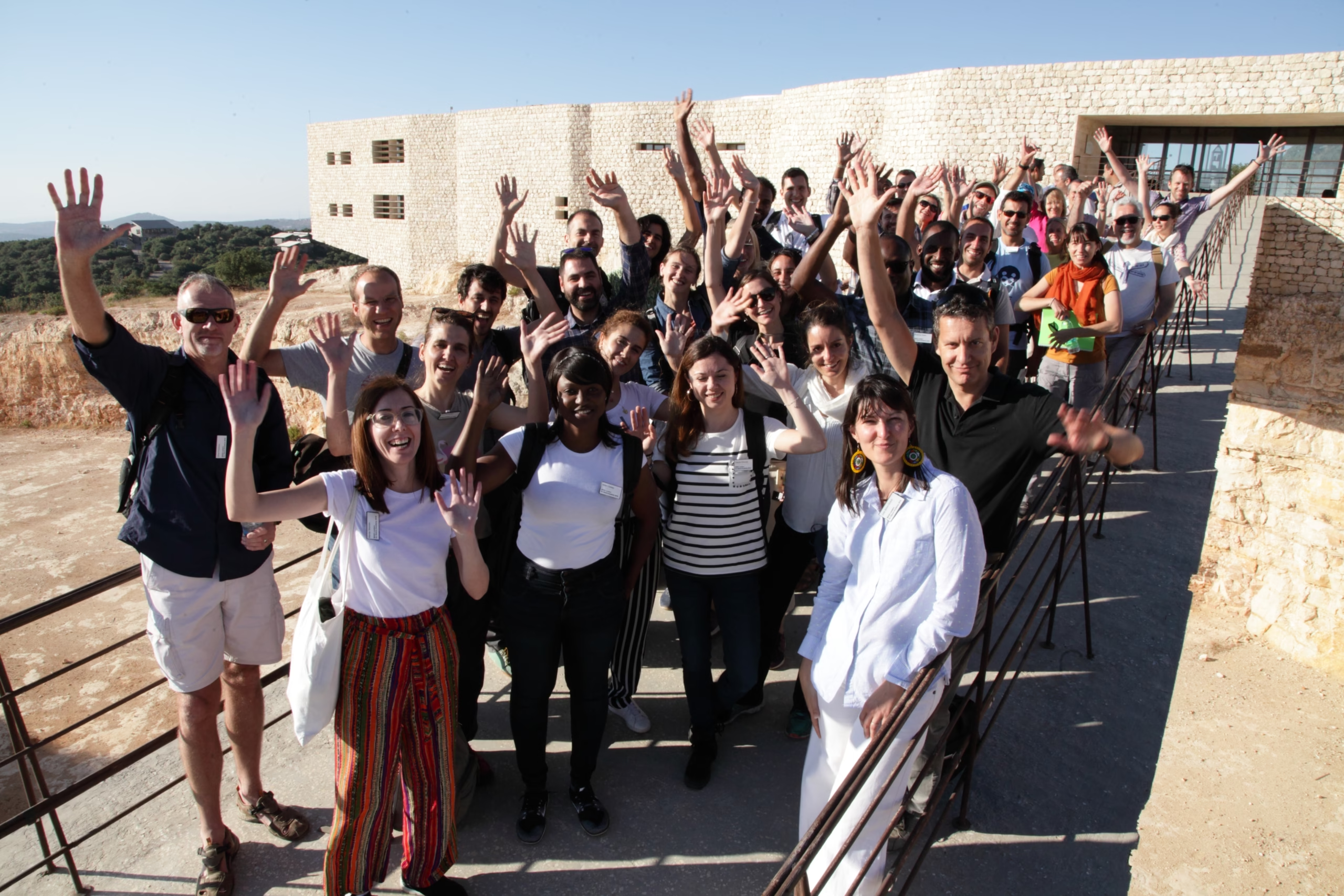
Source: MAVA Leaders for Nature Academy, 2019
"The results will be seen in 10 to 30 years. It is creating a movement and changing the generation who are, and will be, leading conservation efforts."
Jovan Andevski, Programmes Manager, Vulture Conservation Foundation
MAVA Leaders for Nature Academy
Explore the evidence
The multiplier effect
The MAVA Leaders for Nature Academy didn't just develop 176 leaders. It built the relationships that generated an entire ecosystem of subsequent programmes. The investment does not end when the programme does. It multiplies.
A moment to reflect
These are not diagnostic questions with right or wrong answers. They are an invitation to think honestly about the ecosystem you are building and what it might need.
Question 1 of 3
The organisations you fund are doing important work. How much of your investment goes into the work itself and how much into the people leading it?
Question 2 of 3
How many of your grantees or partners are actively collaborating with each other, not just with you?
Question 3 of 3
What does sustained impact look like in your portfolio, beyond the grant cycle?
If any of these surfaced something about how you invest, what you're building, and whether the people carrying the work have what they need — we'd welcome a conversation.
Get in touch with The Human EdgePossible pathways
What we have consistently seen is that the strongest outcomes — for individuals, organisations and ecosystems — emerge when multiple layers of support are integrated over time rather than delivered once and ended. The components that matter most are not complicated:
Structured mentoring
Reduces isolation and builds confidence and resilience
Peer learning spaces
Encourage collaboration and cross-organisational connection
Leadership development
Grows with the leader as their responsibilities grow
Alumni networks
Maintain relationships and ecosystem connectivity long after a formal programme concludes
What holds these components together is not a curriculum. It is structure: the consistency, accountability and trusted support that enables what happens in a mentoring relationship or a peer learning space to translate into sustained change rather than a single moment of insight.
The evidence suggests four broad pathways, each suited to different contexts, ambitions and levels of investment. They can operate as standalone interventions or be layered over time as an ecosystem matures.
The pathway matters less than the quality of what surrounds it. The question is not which pathway to choose, it is what you are trying to build and whether the infrastructure around the relationships is designed to make that possible.
An open door
The Human Edge works with leaders, organisations and ecosystems to build the relational and leadership infrastructure that makes lasting impact possible. Mentoring is at the heart of everything we do — not as a programme feature, but as a philosophy: that people, given the right support, are capable of far more than they are currently asked to carry alone.
Not a pitch. A genuine conversation about what you are trying to build, what is getting in the way, and whether the kind of investment described in these pages might be part of the answer.
If this piece has described something you recognise in the leaders you fund, in the ecosystems you are trying to strengthen, in the gap between the ambition of the sector and its current capacity to deliver, we would welcome a conversation.
✉ info@humanedge.org.uk